
Cincinnati Resident Lookup Record Coverage
No official Cincinnati roster identifies everyone who lives in the city. Instead, the useful records are held by different Hamilton County offices. The Hamilton County Auditor Property Search links a tax-record owner, tax mailing address, situs address, parcel and transfer information. That can establish an ownership record, but it cannot establish who currently lives at the situs. A name may also appear in a recorded instrument, a voter-status return, a court case, or a probate matter. The role and date attached to each result matter as much as the name.
| Record | What It Confirms | Where | Access |
|---|---|---|---|
| Tax parcel | Tax-record owner, mailing address, situs, parcel, transfer facts | Hamilton County Auditor Property Search | Public property data; ownership is not occupancy |
| Recorded instrument | Party role, recording date, legal description, instrument or Book/Page | Recorder Acclaim | Free index; images or printing follow the Recorder access route |
| Voter status | Submitted address, precinct, polling place and district information | Hamilton County Board of Elections | Exact name-and-address confirmation, with protected records excluded |
| Court index | Case category, caption, party role, dates and docket | Hamilton County Clerk of Courts | Public index; remote documents may be unavailable |
| Probate or marriage index | Estate, guardianship, marriage or archive result | Hamilton County Probate Court | Coverage and access differ by category |
Begin with the record closest to the question. A claimed owned address points to the Auditor and Recorder. A claimed voting address calls for the Board of Elections form. A case number or a court dispute belongs with the Clerk. A family-history question involving an estate or marriage belongs with Probate. A result becomes stronger only when the address, time period, and role agree across records.
Note: A matching name is a lead, not an identity finding, until independent details line up.
Confirming a Cincinnati Resident Claim
Use a short verification chain before treating a record as connected to one person. Keep spellings, suffixes, apartment information, and dates as they appear in the source. The Auditor distinguishes a situs, meaning the property location, from a tax-bill mailing address. The Recorder can then connect the parcel to a recorded legal description. Where an exact residence claim is available, the voter-status form is a separate check rather than a way to browse people.
- Search the Auditor by the known address, owner name, or parcel and record the situs, mailing field, transfer information, and parcel identifier separately.
- Use Acclaim to compare the parcel or legal-description trail with the named person’s actual role in the instrument.
- Enter the exact name and address details in the Board of Elections status form when a registration confirmation is the question.
- Check court or Probate only for the relevant case category, then capture the caption, party role, date, and docket before requesting a public copy.
- Docket
- A dated list of actions and filings in a court case. It shows the case’s progress, not proof of identity by itself.
- Index and image
- An index lists searchable record facts. An image is the underlying scanned document, which may have separate access limits.
- Certified copy
- A copy issued by the custodian with its certification. It is requested from the office holding the record, not assumed from an online result.
Cincinnati Resident Lookup Voter Status
The Hamilton County Board of Elections registration-status form is designed for a particular person and address. It requires first name, last name, including suffix where applicable, street number, street name, street suffix, and ZIP Code. The form instructs users to leave out street directions and punctuation. On a match, it returns the voter’s name and address along with precinct, polling location and entrance, polling address and city, legislative districts, and school-district information.
That is an exact-claim test, not a street-wide directory. A failed return can reflect a spelling or suffix difference, an address-format mismatch, voter-list maintenance, or a protected record. Ohio Revised Code §3503.13 makes designated registration material public while excluding several identifying and protected categories. It also does not reveal how anyone voted.
Note: Compare the returned address with the form entered before drawing any conclusion from a no-match.
Cincinnati Resident Lookup Land Records
Hamilton County Recorder Acclaim is the bridge from a person’s name to recorded land documents. Its search modes include Name, Record Date, Date Range and Document Type, Book/Page, Document Number, Subdivision/Lot, Auditor Number, Subdivision Name, and Certificate Number. For most modern documents, the Recorder directs researchers to the ordinary name route, generally for records from 1988 forward. Earlier work usually begins with historic grantor and grantee indexes, then moves to Book/Page.
Acclaim’s older land trail reaches much further, with deed-book indexes beginning in 1794. A recorded name can identify an owner, lender, trustee, lienholder, corporate officer, or another party. Confirm the party role and legal description before treating a result as a residence connection. If the online index stops short of a needed nonexempt record, use the Recorder’s historic-record links, counter, or a narrowly described request rather than guessing from a similar name.
Cincinnati Resident Lookup Court Results
The Clerk’s Name Search starts with a Cases chooser. Its checkboxes cover Common Pleas Civil, Common Pleas Criminal, Municipal Civil, Municipal Criminal/Traffic, Domestic Relations, and Court of Appeals. The fields are Last Name, First Name, DOB for criminal cases only, Company Name, Begin date, and Ending date. It is worth choosing the actual court category and preserving the search date. City parking violations are excluded from this name portal.
The Clerk’s official Name Search screen shows the court categories and name fields used for a Cincinnati resident lookup.
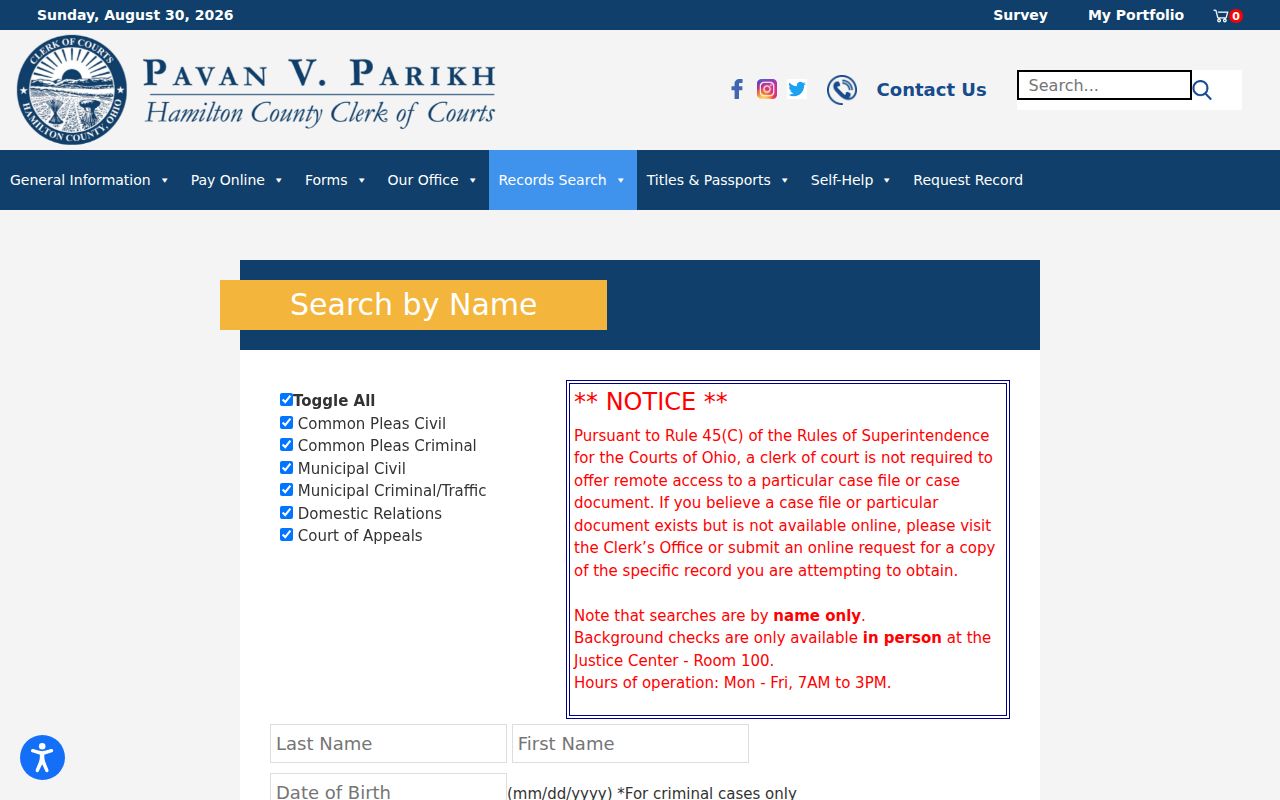
Use the visible court category and supported name details to narrow candidates, then compare the resulting role and case dates with independent records.
When a case number is known, the Clerk’s Case Number Search repeats those six category choices and adds the Case Number field. Copy it exactly. A useful result inventory is: court and category, case number, styled caption, party role, filing or disposition date, docket entries, document title, and whether a document is actually viewable. Those fields show a case connection, not a current address or a confirmed identity.
The official case-number screen is a separate route once a Cincinnati resident lookup has produced a reliable case number.
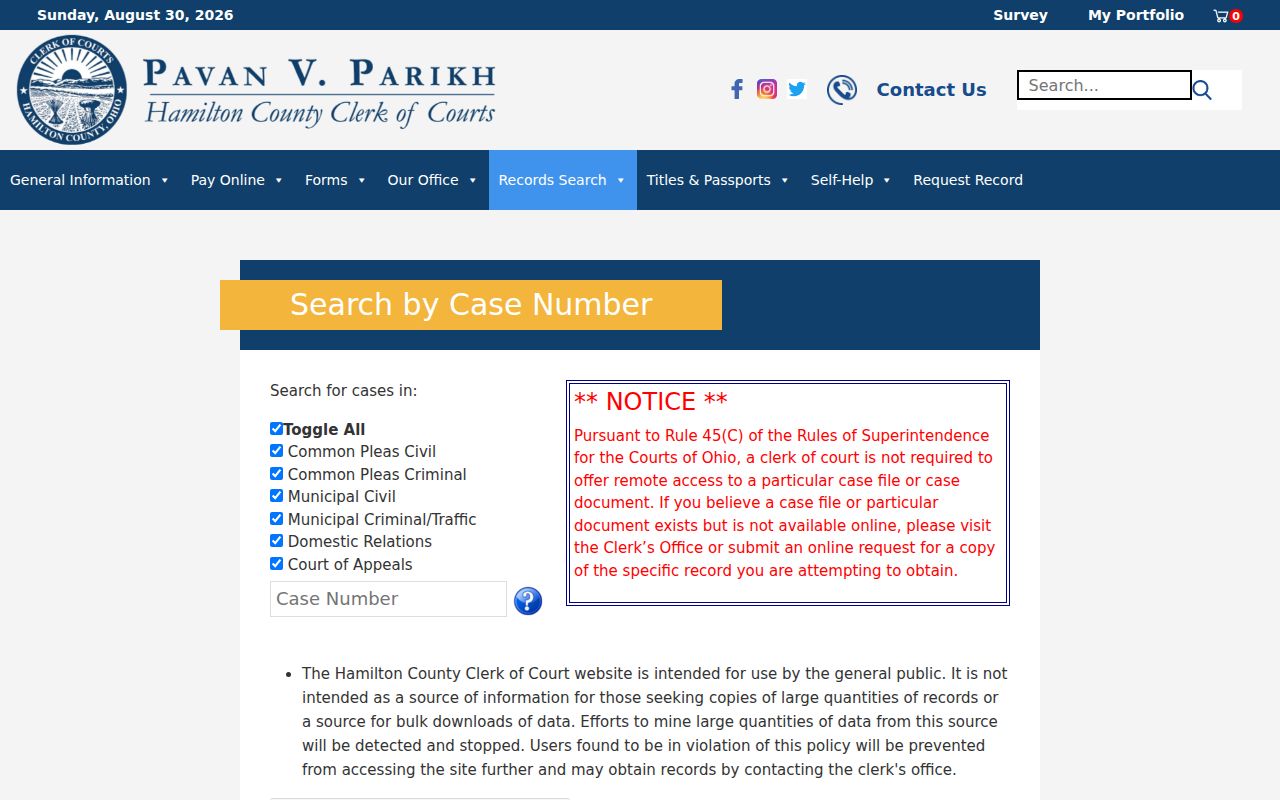
Case number, category, caption, and docket history should agree before a person is associated with a court file.
Cincinnati Resident Lookup Probate Routes
Hamilton County Probate Court Record Search is separate from the Clerk system. It has Case Search, Marriage License, and Archive Search routes. Its case index generally begins in 1974, docket material in 1993, documents in 2000, and the marriage index in 1984. Archive holdings can reach to 1791. Case detail can show the case number, type or status, caption, party role, attorney when present, dated docket rows, and document-description or view controls.
Probate is the better path for an estate, guardianship, marriage-index, or archival question. It should not be merged with an adult Clerk result merely because the names look alike. The 1884 courthouse destruction is also not a simple blank spot. The Hamilton County FamilySearch collection identifies restored Probate series, including administration proceedings from 1884 to 1915. Search the described restored series when the date fits, and treat each catalogued series as its own record set.
When Cincinnati Court Results End
A remote court no-result does not prove that a case never existed. Ohio Superintendence Rule 45(C), sealing, redaction, juvenile protections, adoption limits, and archive coverage can affect online display. The Clerk says remote access to a particular document is not guaranteed. That is a search limitation, not a finding about a person. Record the selected court categories, exact terms, dates, and the portal message so a later request can be precise.
For a needed public copy, use the Clerk’s records-request route or its counter at 1000 Main Street, Cincinnati, during listed weekday hours of 8 a.m. to 4 p.m. The request page lists ordinary copies at $0.10 per page and certified copies at $1 per page, with possible media or postage charges. If no portal or counter route exposes a nonexempt record, make a narrow request under the Ohio Public Records Act, R.C. 149.43 to the office that keeps it.
Note: Ask for the nonexempt portion and the stated legal basis when a public-record request is denied or redacted.
Cincinnati Resident Lookup Privacy Limits
Some records are public only in a limited form, and others are confidential. Ohio Safe at Home protects qualifying participants’ addresses. R.C. 149.45 provides a process for eligible people to seek online redaction of specified personal information. Protected voter records and other exclusions mean an absent record cannot be used as proof that a person has no connection to Cincinnati. Corrections also belong with the custodian that created the record, such as the Auditor, Recorder, Board of Elections, Clerk, Probate Court, or state agency.
The Ohio DRC Offender Search is a separate custody or supervision locator, not a general Cincinnati address record.
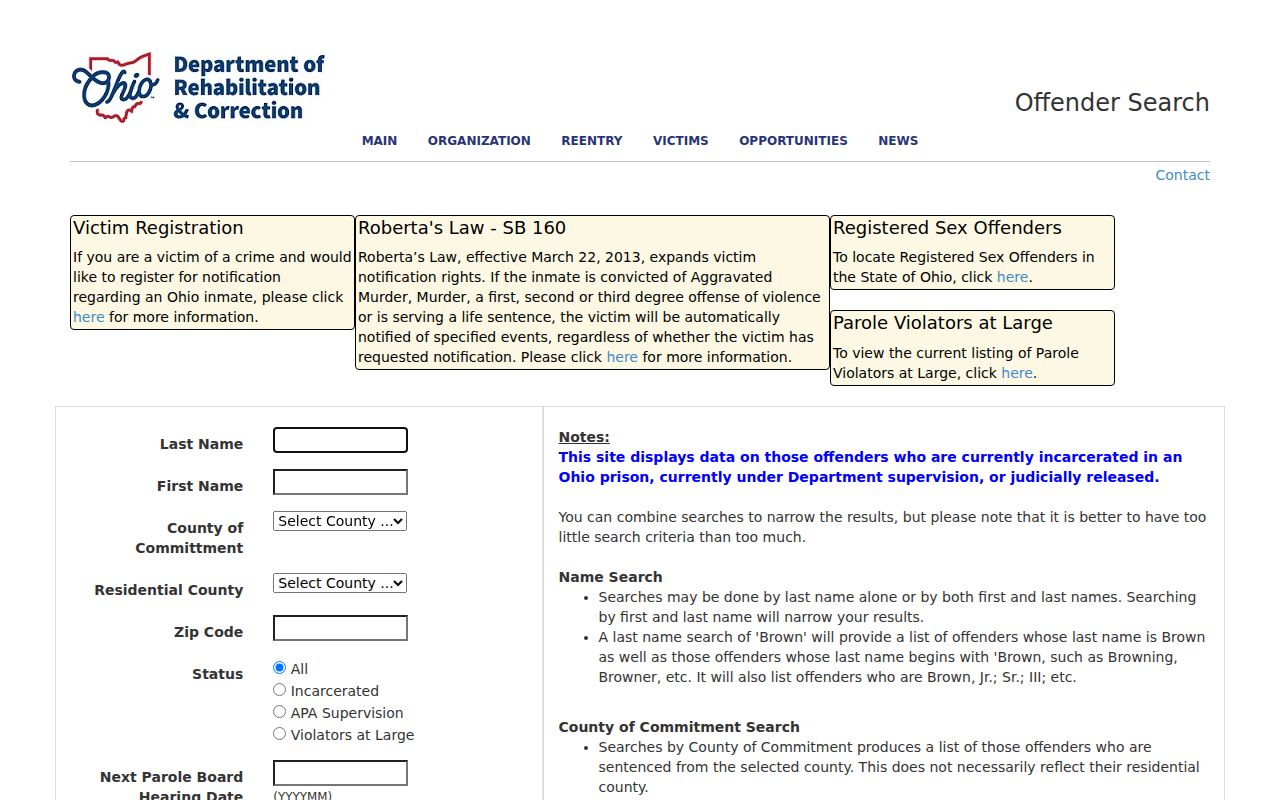
A custody or supervision result must be read under that system’s terms and does not establish present residence, family connection, or a complete record history.
Lawful use. Use public records for lawful personal research. Stalking, threats, and harassing communications are prohibited by Ohio law, including R.C. 2903.211 and R.C. 2917.21.
Ohio Adoption File Route
Adoption is not a routine Cincinnati resident lookup. Ohio Revised Code §§3107.45 through 3107.53 set the disclosure route for adoption files and identifying information. R.C. 3107.47 describes release conditions tied to the adoption file and a valid denial-of-release form. Use the formal Ohio adoption-record path rather than attempting to infer adoption information from court, voter, or property results.
The local vital-record counter and Probate search do not substitute for that statutory route. A lawful request should follow the state’s eligibility, identification, signature, and fee requirements for the particular record.