
Cincinnati City Directory Collections
The Cincinnati & Hamilton County Public Library, or CHPL, is the central local collection. Its Genealogy & Local History Department at the Downtown Main Library holds city directories alongside maps, census material, church and cemetery records, and other local sources. CHPL describes its Cincinnati directory holdings as 1819 to the present, while its digital collection supplies a searchable selection rather than proof that every annual issue is online. Ask the department about an unscanned year at research@chpl.org or 513-369-6909.
| Collection | Years | Where held | Access |
|---|---|---|---|
| The Cincinnati Directory and early successors | 1819, with digitized early volumes through 1846 | CHPL City & County Directories | Searchable digital collection and library holdings |
| Williams' Cincinnati Directory | Digitized examples 1849-50 through 1955 | CHPL Digital Library and Cincinnati Room source collection | Full-text viewer and browser PDF parts |
| Pink Pages and Criss-Cross | Pink Pages from 1925; name changed in 1941 | CHPL Genealogy & Local History resources | Address-ordered research; exact shelf run should be confirmed |
| Greater Cincinnati telephone directories | Digitized examples from winter 1935-36 through winter 1938-39 | CHPL City & County Directories | Use the displayed season and year as a dated cross-check |
The earliest known 1819 directory, compiled as “A Citizen,” recorded 1,693 names. Later collections have more depth, but the initial volume is a useful scale marker rather than a census of every person in the city. Publisher names and coverage should always come from the particular volume, because early directory history includes several documented compilers and printers.
Cincinnati City Directory Timeline
Dates matter because the printed locality may not match a current municipal label. The 1905 Williams volume, for example, lists Avondale, Bond Hill, Clifton, Evanston, Hyde Park, Linwood, Riverside, Westwood, and Winton Place in its scope. Preserve the place name printed with an entry. It may describe a community or boundary arrangement that differs from a later map.
- 1819: The Cincinnati Directory appears with 1,693 names in the retrospective account printed in the 1849-50 volume.
- 1849-50: The digitized Williams run begins with a volume that records the earlier succession of Cincinnati directories.
- 1905: A Williams volume describes itself as the 55th annual issue and includes alphabetical, street, business, and municipal material.
- 1925 and 1941: Pink Pages begin the address-order layer in 1925, then carry the Criss-Cross name by 1941.
- 1955: CHPL's digital collection includes Williams objects through this year, although the public selection does not establish that each intervening year is online.
That timeline gives a search a fixed date frame. It also prevents a present-day address or neighborhood name from being silently substituted into an older printed source.
Search Cincinnati City Directory Scans
The CHPL City & County Directories collection supports both a search within a selected record and a collection search. A viewer may provide page navigation and long volumes can be split into browser-PDF parts. Search with a surname, a surname root, initials, a street, a business, or a phrase. If OCR misses a name, those alternate approaches can expose the page. A no-result is not proof that the entry is absent.
Open the digitized Cincinnati city directory collection to search the available volume objects and inspect their scans.
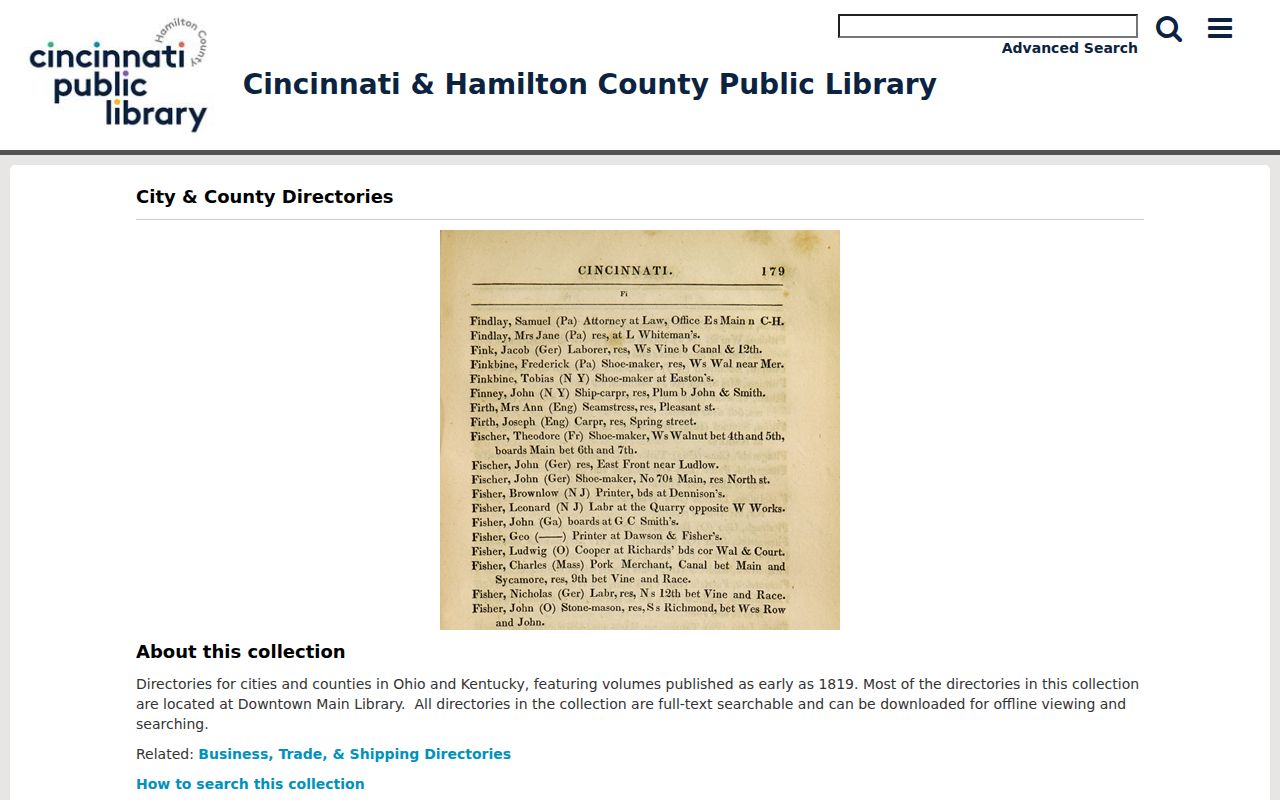
The collection is a starting point for image verification, not a substitute for reading the printed page. CHPL warns that optical-character-recognition text can be incomplete or inaccurate, so compare every useful hit with the page image.
For a 1905 volume, the PDF parts continue through alphabetical and municipal material. A surname can also appear under a cross-reference, so test spelling variants before deciding that a person is not represented.
Reading Cincinnati City Directory Entries
Williams entries usually put the surname first, then a given name or initials and a compact set of details. The 1905 volume shows personal names, an occupation or role, a work location in many cases, and a residence introduced by h. It also uses wid for a widow and can show room notation, firm affiliation, a place after res, or a “See also” cross-reference. Transcribe the punctuation and abbreviations rather than expanding a line from memory.
| Name order | Surname first, then given name or initials; a dash can continue a surname group. |
|---|---|
| Occupation or role | A concise description that may be followed by a firm, office, or work location. |
| h | The printed home or residence address in the entry. |
| wid | A widow notation that can provide a relationship clue and a name to investigate in earlier records. |
| res, rooms, and cross-references | A place outside Cincinnati, a room or flat detail, or a spelling path to another entry. |
An entry is evidence of what the publisher printed for that date. It does not prove a precise move date, a complete household, continuing residence, or a property interest.
Cincinnati Directory Reading Terms
Later Cincinnati volumes use parts that serve different kinds of research. Identify the part before copying a result, because a name list and a street list answer different questions.
- Criss-Cross Directory
- An address-ordered directory. It lets a researcher scan the printed number sequence on a street for a particular year.
- Householder directory
- A section organized around household or address information rather than only a surname alphabet.
- Abbreviation key
- The volume's printed explanation of short forms. Photograph or note it before expanding an entry.
- Street and Avenue Guide
- A civic reference section that can help interpret the published street layout and related numbering.
The 1925 table of contents explicitly lists a Cincinnati Street Directory, Directory of Householders, and Street and Avenue Guide. Start with the part that fits the known name or address.
Cincinnati City Directory Address Changes
Most Cincinnati street addresses changed in 1895. A number from a nineteenth-century directory should therefore not be entered directly into a current parcel system. CHPL's house-history guidance points to the 1883/84 Robinson atlases and 1891 Sanborn maps for the old-numbered core, then to 1904-and-later maps for the new numbering. Match the directory issue to the map nearest its date before comparing an address across the break.
The CHPL House History resources describe both the numbering change and the address-order research route. This local quirk can explain why a well-transcribed old entry appears to miss a present-day address.
Note: A matching number on the same street is not enough when the source predates the 1895 renumbering.
Trace Cincinnati City Directory Households
A household trail works best when it is assembled one dated source at a time. Exact transcription is the first safeguard. Use an address-ordered directory for the candidate at a particular building, then test that entry with a map and a federal census. The newest released federal census is 1950, so its name, city or county, and enumeration-district routes can help anchor a directory entry without treating a later directory line as current information.
- Choose the Williams or other Cincinnati volume closest to the known year and transcribe the entry exactly, including initials, h residence, work detail, and page or image identifier.
- Follow the name through nearby years, noting each address form and any spelling, firm, or relationship notation that changes.
- For 1925 and later, use Pink Pages or Criss-Cross material to test the address in printed number order for that specific year.
- Pair the directory year with a released census and, when needed, its ward or enumeration-district map. Compare names and ages instead of assuming a shared surname is the same household.
- Use a parcel, recorded document, obituary citation, or cemetery record as a separate dated check. Keep each source's role in the final note.
A name disappearing from a directory can reflect a move, death, a changed spelling, a different coverage area, or a publisher choice. Search the next available year, related street entries, newspaper citations, and map context before drawing a conclusion.
Cincinnati Archives After Directories
When a digital directory result needs context, CHPL's Genealogy & Local History Department is at 800 Vine Street in the Downtown Main Library. Its Genealogy & Local History resources identify city directories, maps, census material, church and cemetery records, and research assistance. The library's newspaper databases and Newsdex index can provide a dated article citation, which should then be retrieved and read rather than treated as a complete biographical record.
Visit the CHPL Digital Library to move from a directory citation into the library's broader digitized Cincinnati material.
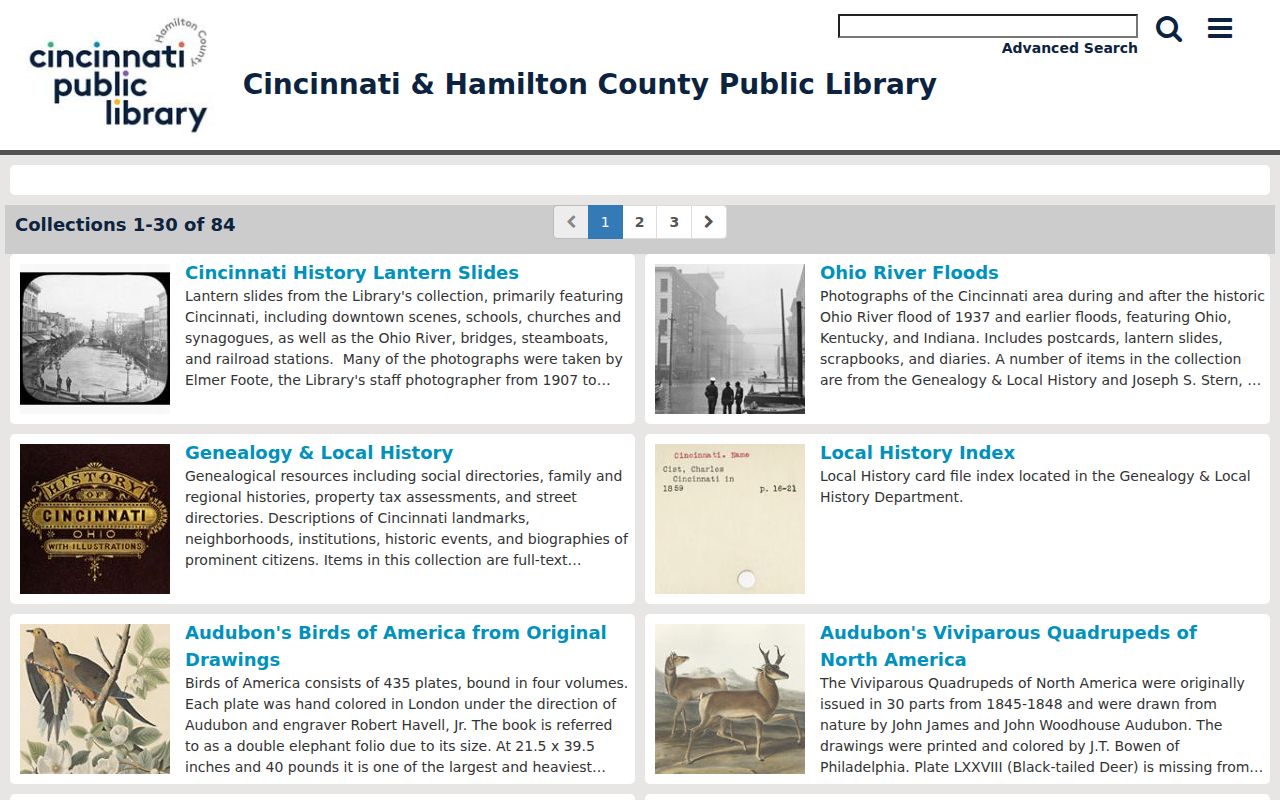
The digital library view is a useful handoff from a compact directory line to maps, photographs, and other dated local material. Keep each object’s title, date, and image reference with the directory citation.
For manuscripts, maps, photographs, and local printed material, the Cincinnati History Library & Archives is a useful next stop. CHLA research is appointment-only on Thursday and Friday from noon to 4 p.m.; email library@cincymuseum.org in advance because some material is stored off site. The FamilySearch Hamilton County collection also provides browseable Recorder and Probate material with series-specific coverage dates.
Those repositories are companions to the Cincinnati city directory shelf. They can test a date, place an address on a map, or provide a document image that a compact printed entry cannot supply.
Cincinnati City Directory Limits
Printed directories are selective, dated publications. A line can omit a person, use an abbreviation, cover an area outside the present city boundary, or contain a scanning error. Telephone-era volumes may reduce some earlier detail to make room for numbers. The safest record is the combination of the printed image, its year, the exact words transcribed, and one independent source that addresses the same person or place.
Open the CHPL Digital Library when the object is available, and ask CHPL staff about a volume that is not. A missing online scan does not prove that the library lacks the issue, and a name match is never enough to merge two same-name people into one history.
For a present-day address question, use the parcel-and-title workflow in the Cincinnati Street Directory rather than extending a historical directory entry beyond its printed date.